The independent builder running a self-running operation has a specific requirement: the system does the work, with or without them at the desk. An email list built on that principle looks very different from an email list treated as a manual broadcast tool. Here is what the working version looks like, and what the numbers that underpin it actually reveal.
If the foundational case for building a list over a social following is still forming, the argument is laid out in full here: Email List vs. Social Following: Why Every Follower You Have Is Borrowed.
Tuesday Morning, 6 AM
A subscriber found a pin at 5:53 AM and opted in. By 6:01 AM, Email 1 was already in their inbox. It delivered the promised resource, established the voice, and laid out what is coming over the next two weeks. No one sent it. It was written once, loaded into the automation sequence, and it has been running ever since. For that subscriber and for every subscriber who preceded them.
This is the first thing most builders underestimate about a properly structured email list. The welcome email, the one that lands within minutes of opt-in, achieves an average open rate of 68.6 percent across email platforms [1]. That is not exceptional for this category. It is the baseline. Welcome emails consistently outperform every other message type in a sequence because timing is doing most of the work. The subscriber has just made an active decision. They are at peak interest. An email that lands in that window is received entirely differently from a broadcast campaign that arrives days or weeks later, when the initial motivation has faded.
That welcome email is doing real relationship work while the operator is asleep, traveling, or building something else entirely. Self-running infrastructure means the work continues when you step away. The welcome sequence is where that begins.

What Each Email in the Sequence Is Actually Doing
Emails 2 through 10 follow on a preset schedule, each with a specific strategic purpose, and it is worth being precise about this, because the sequence is not simply a series of messages. It is a calibrated trust-building architecture.
Email 2 establishes positioning: why this list exists, what the brand stands for, what it does not. Email 3 delivers a single specific useful insight that demonstrates the recommendations come from operational experience, not aggregation. Emails 4 through 7 continue the trust-building progression , social proof, problem framing, a considered contrarian position, a look inside the tools and process. By the time Email 8 arrives, the resource email, where specific platform recommendations and affiliate links live, the subscriber has had seven prior touchpoints. They know the voice. They have received value. The recommendation lands in a context of established trust.
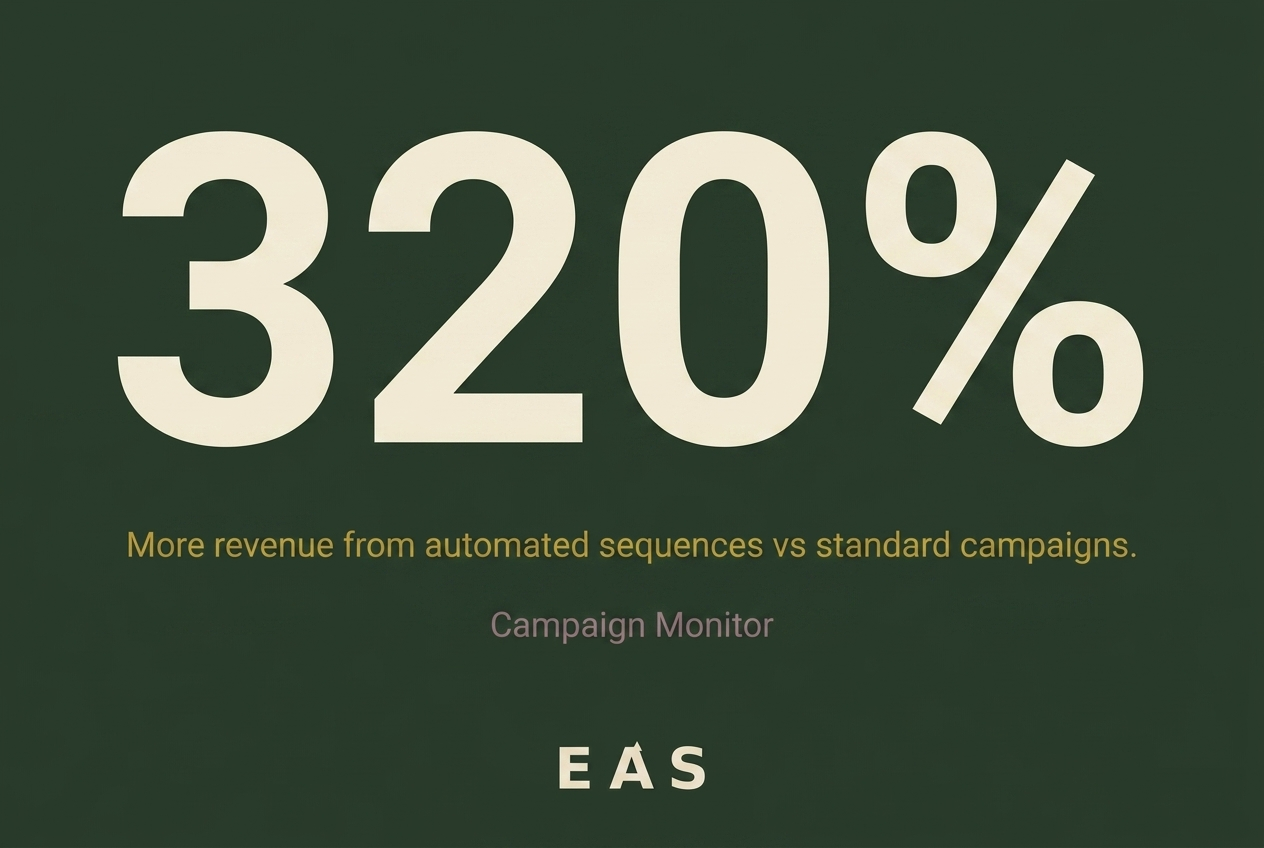
This architecture is not decorative. Automated email sequences generate 320 percent more revenue than standard broadcast campaigns sent without automation [2]. The difference is not in the quality of the writing. It is in the timing and sequencing, the fact that each subscriber, regardless of when they joined, receives the same calibrated progression from Email 1 to Email 10.
There is also the attention metric. Email users spend an average of 11.1 seconds reading a brand email, compared to 1.7 seconds of attention a social media post receives before a user scrolls past [3]. A sequence of ten emails, each receiving eleven seconds of focused attention, generates nearly two minutes of uninterrupted contact time with a subscriber who opted in specifically to receive the content. That quality of attention is not available through any social channel at any follower count.
What the List Produces at Scale
Kit, the platform built specifically for independent creator email operations, is used by over 600,000 creators who collectively send more than 2.5 billion emails per month [4]. Those numbers reflect a specific kind of decision, builders who concluded that the email list, not the social following, was the asset worth investing in and building infrastructure around.
The financial returns confirm the decision. Email marketing consistently delivers between $36 and $40 for every dollar spent [5]. Social media marketing returns approximately $2.80 per dollar. The gap is not marginal, and across the industry data available through 2025 and 2026, it has not been closing. The independent builder who treats the email list as primary infrastructure is operating with a fundamentally different financial model than one who is optimizing primarily for social metrics.
It is also worth noting what the entry point looks like. Kit's free tier supports up to 10,000 subscribers with unlimited email sends and one automated sequence. A creator can build a list of ten thousand engaged subscribers, run a complete welcome automation, and generate revenue through that list before paying anything for the platform. The infrastructure cost to start is zero.

Behavioral Signals Replace Manual Monitoring
A basic welcome sequence is already a significant upgrade over social-only operations. The more sophisticated version, which Kit enables through its visual automation builder, is what makes the operation genuinely self-managing.
Consider what behavioral tagging makes possible in practice. A subscriber who clicks the affiliate link in Email 8 can be tagged automatically as high-intent and entered into a separate follow-up sequence designed for warmer leads. A subscriber who opens every email but never clicks receives a re-engagement message at a defined interval, designed to prompt a response and identify what would actually be useful to them. A subscriber who does not open the first three emails can be removed from the active sequence automatically, keeping the list clean and deliverability rates stable.
None of this requires watching the list. The operator defines the logic once, this action triggers this response, this inaction triggers that follow-up, and Kit executes it continuously for every subscriber at any scale. The sequence adapts to real engagement signals in real time. The operator is not the bottleneck.
This is the specific operational value of a platform like Kit compared to a basic broadcast tool. The difference is not visual. A broadcast tool sends the same message to everyone and waits for results. An automation platform reads behavior, segments the audience continuously, and routes each subscriber toward the next right message for them specifically. The list becomes intelligent. It responds to the individual rather than treating every subscriber as identical.
Email Automation Logic, How the Sequence Routes Subscribers
What the Operation Looks Like from the Outside
From the outside, the self-running builder appears resourced in a way that does not match what a one-person operation should produce. New subscribers are receiving polished, timely, relevant emails. The sequence is progressing at the designed pace. Recommendations are converting. The brand voice is consistent across every touchpoint, regardless of what else is happening in the business that week.
From the inside, it is an architecture built once, tested once, and running continuously. The operator maintains it, improves it when data suggests a change, and directs traffic into it. That is a fundamentally different relationship with the work than writing and sending campaigns manually each week.
The compounding effect deserves to be stated directly. A welcome sequence activated in April continues working in October and the following April. Every subscriber who enters the list in any subsequent month starts the same calibrated sequence from Email 1. The investment in writing ten emails once produces returns across every subscriber who ever opts in, not just the cohort who joined in the week the sequence was written.

Common Questions
Do I need a large list for this architecture to work?
No. The automation logic operates identically for a list of 50 as it does for 50,000. Every behavioral tag activates, every follow-up fires, every routing decision executes, at any list size. The case for building the infrastructure early, before the list is large, is that the system is already optimized and running by the time growth accelerates. Starting later means leaving the early subscribers in a less calibrated experience.
What specifically makes Kit suited to this kind of operation?
Kit was designed for independent creators, which means the feature architecture is oriented precisely toward the use cases described here: visual automation builders, behavioral tagging, subscriber segmentation, and clean deliverability management. It also integrates natively with over 100 external platforms: Shopify, Teachable, Stripe, Zapier, and others, meaning the email infrastructure can connect to whatever tools already power the operation rather than running in isolation.
How long before the sequence starts producing results?
Welcome emails average a 68.6 percent open rate from day one [1]. The relationship-building begins with the first opt-in. Conversion results, affiliate clicks, product engagement, downstream actions, typically emerge once subscribers have moved through Emails 7 and 8, which occurs approximately two weeks into the sequence at the standard two-day sending interval. The timeline is not instant. It is predictable, and it compounds with each new subscriber who enters.
Get the Welcome Sequence Blueprint
Ten complete email templates, subject lines, body copy, and purpose documented for each. Ready to load into Kit and activate on the first opt-in. The infrastructure cost is zero to start.
Get the Free BlueprintReferences
[1] DemandSage. "89 Email Marketing Statistics Of 2026." demandsage.com. January 2026.
demandsage.com/email-marketing-statistics/
[2] Campaign Monitor. Cited in Sixth City Marketing. "115+ Email Marketing Statistics for 2026." sixthcitymarketing.com.
sixthcitymarketing.com/email-marketing-stats/
[3] Harman Media & Marketing Group. "Email Marketing vs Social Media: ROI Comparison." thm2g.com. December 2025.
thm2g.com/email-marketing-vs-social-media-roi-comparison/
[4] Blogging Wizard. "Kit (formerly ConvertKit) Review and Tutorial." bloggingwizard.com. Updated 2026. Citing Kit platform data.
bloggingwizard.com/convertkit-review-and-tutorial/
[5] Litmus. "State of Email 2025." litmus.com. Cited across HubSpot, EmailMonday, and multiple 2025, 2026 industry benchmark reports.
litmus.com/blog/infographic-the-roi-of-email-marketing