There is a version of this story that plays out regularly in independent builder communities, and it follows the same pattern every time. Someone spends two years building a following on a platform. The content is good. The engagement is real. The saves and shares feel like momentum. Then the algorithm shifts, the reach collapses, or the account gets flagged and restricted, and the audience that took years to build becomes unreachable overnight.
This is not a rare edge case. It is the structural reality of building on platforms you do not own.

The Platform Problem Is a Property Problem
When you build an audience on Instagram, TikTok, or LinkedIn, you are not building an asset. You are renting one. The platform controls who sees your content, under what conditions, and at what cost. Every follower you have is a relationship mediated by a third party whose interests are not aligned with yours.
Consider what has happened to organic reach over the past decade. In 2012, a post from a Facebook business page reached roughly 16 percent of its followers. By 2026, that figure sits between 1 and 3 percent [1]. A business with 10,000 Facebook followers that publishes a post today can expect somewhere between 100 and 300 people to see it. The other 9,700 followers, people who explicitly chose to follow that business, will not know the post exists unless the algorithm decides otherwise, which increasingly requires paid promotion to trigger.
Instagram has followed the same trajectory. Average organic reach on Instagram dropped another 12 percent year-on-year through 2024 and 2025, with typical posts now reaching roughly 3 to 4 percent of followers [2]. The pattern is consistent across platforms because the economic logic is consistent: social platforms are advertising businesses. Their revenue comes from brands paying to reach users. When organic reach was high, businesses had limited incentive to pay. As organic reach has declined, the financial pressure to pay for distribution has grown proportionally. This is not accidental. It is the product.
The point is not that social platforms are without value. Pinterest, used with a long-shelf content strategy, continues to function as a discovery engine with a reach model that is structurally different from Facebook and Instagram. The point is that the follower relationship, the subscriber, the fan, does not belong to the builder. It belongs to the platform. And platforms can change the rules of access at any time, for any reason, with no obligation to notify you in advance.
Facebook Organic Reach, Business Pages, 2012 to 2026
Sources: Gray Reserve, Socialinsider, Hootsuite longitudinal data [1][2]
What the McKinsey Number Actually Means
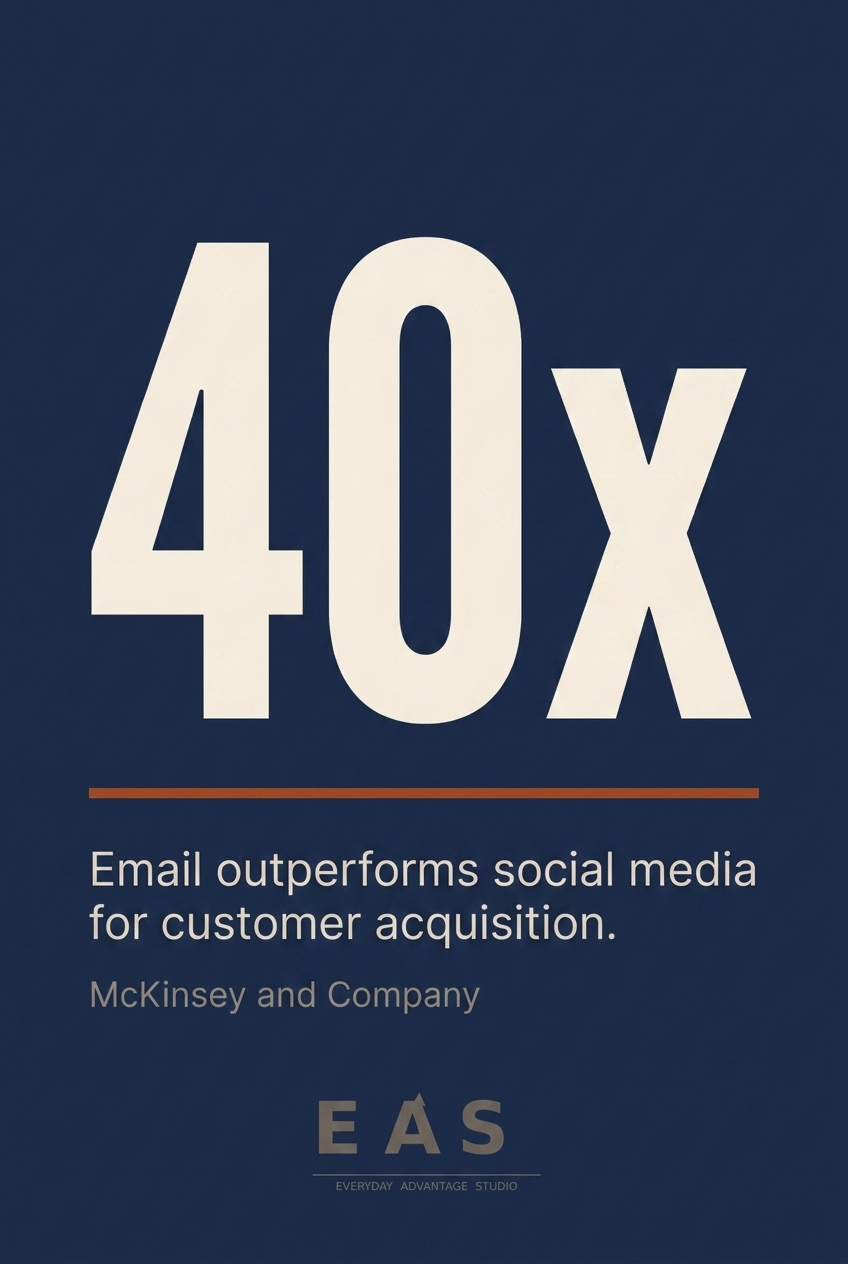
Research from McKinsey found that email is nearly 40 times more effective than social media for customer acquisition [3]. That figure circulates widely in marketing discussions, but it is worth sitting with what it actually means in operational terms for a one-person or small-team business.
The McKinsey research was examining how companies acquire customers, not impressions, not engagement, not follows. Customers. The finding reflects a fundamental structural distinction between how the two channels work. A social follower is a passive connection. They may have tapped a button once and moved on. They have not provided their contact information. They cannot be reached directly. The algorithm decides whether they see the next post, and at current organic reach rates, the probability is low.
An email subscriber has made an active, considered decision. They have provided their email address, confirmed their interest, and consented to ongoing communication. That permission creates a direct channel with no intermediary and no algorithmic gatekeeper. The inbox belongs to the subscriber. The email platform delivers the message. Nothing in between is deciding whether it surfaces.
This is what the 40x figure reflects. It is not simply that email performs better in A/B tests. It reflects the structural difference between a relationship that belongs to you and one that is rented from someone else, where access to the relationship can be reduced or revoked without warning.
The Conversion Gap in Concrete Terms
The operational difference extends to conversion rates. Email marketing carries an average conversion rate of approximately 6 to 8 percent. Social media marketing averages around 3 percent [4]. Those are not similar figures. An email list of 1,000 subscribers converting at 6 percent generates 60 customers. A social following of 1,000 people converting at 3 percent, after platform organic reach of 3 percent surfaces the post to 30 of them, generates fewer than one.
The ROI gap is equally direct. Email marketing consistently delivers between $36 and $40 for every dollar spent. Social media marketing returns approximately $2.80 per dollar [5]. The comparison is not close, and it has not been closing. The gap reflects the same structural distinction as the 40x acquisition figure: the email relationship is direct, permission-based, and durable. The social relationship is mediated, passive, and subject to platform decisions.
Email subscribers are also 3 to 5 times more engaged than social media audiences on a per-contact basis [5]. This reflects the quality of the relationship, not just the channel mechanics. Someone who has opted in, confirmed, and opened a welcome email is categorically different from someone who tapped a follow button two years ago and has since seen 0.3 percent of the posts that account has published.
This is why four out of five marketers say they would give up social media before they would give up their email list [6]. Not because social media is without value, it serves discovery, brand awareness, and top-of-funnel reach effectively, but because the email list is where the durable business relationship lives. Social is exposure. Email is ownership.
The Owned Channel Distinction
An email list operates differently in one foundational way: the relationship belongs to you. If you move email service providers, the list moves with you. If the platform you use raises prices or shuts down, the list remains intact. If you go dark for six months and return, the subscribers are still there. No algorithm decides whether your next message reaches them.
The independent builder who has a list of two thousand engaged subscribers has a more durable business asset than one who has a following of twenty thousand on a platform with 2 percent organic reach. The list is infrastructure. The social following is exposure. Both have value, but they serve different functions, and treating them as equivalent is an error with compounding consequences.
For a detailed look at what a running, automated email list actually produces day to day, the sequence architecture, behavioral logic, and what the operation looks like from the inside, this post covers the full picture: What a Self-Running Email List Looks Like When It Actually Works.
Why Most Independent Builders Delay This
The most common reason is friction. The sequence of decisions involved in choosing a platform, building an opt-in, writing a welcome sequence, and directing traffic toward it feels like a project for a future version of the business. Meanwhile the social following is visible, growing, and generating enough activity to feel like momentum.
The cost of delay is less visible but real. Every month of social-only audience building is a month of relationship equity that lives entirely in someone else's system. A platform shift, an algorithm update, or an account restriction can invalidate months of that work in a way that an email list, by its nature, cannot be invalidated. The list persists. The infrastructure required to build it is significantly more accessible than most operators assume.

Common Questions
Does the size of the list matter before automation makes sense?
No. The automation logic runs identically for one subscriber as it does for ten thousand. The welcome sequence fires, the follow-up emails deploy, the behavioral tagging activates, all of this operates regardless of list size. Starting with a small list is not a reason to delay building the infrastructure. It is the reason to build it early, so the system is already running and optimized when the list grows.
How long does it take to set up a basic email welcome sequence?
With a complete set of pre-written templates, the technical setup in any major email platform takes a few hours. The time investment is in the writing. That is exactly what the EAS Welcome Sequence Blueprint is designed to remove, the blank-page problem for operators who want to start immediately without writing ten emails from scratch.
Will subscribers actually open automated emails?
Welcome emails, the first automated message a subscriber receives, average a 68.6 percent open rate across platforms [7]. This figure is consistent across the industry because timing is doing most of the work. The subscriber has just opted in, which represents peak interest. An email that lands within minutes of that decision arrives in the window of highest receptivity, before attention has moved elsewhere, before the initial motivation has faded.
Get the Welcome Sequence Blueprint
Ten complete email templates, subject lines, body copy, and strategic purpose for each. Ready to load into any email platform and activate on the first opt-in. The blank-page problem, solved.
Get the Free BlueprintReferences
[1] Gray Reserve. "Organic Social Media Reach Is Dead. Here Is What Replaced It." grayreserve.com. July 2025.
grayreserve.com/articles/social-media-organic-reach-dead
[2] Martech Zone. "Organic Social Media Reach Is Dead: How To Grow Your Following In 2025." martech.zone. May 2025.
martech.zone/organic-reach-is-dead-how-to-grow-on-social-media/
[3] McKinsey & Company. "Why marketers should keep sending you emails." mckinsey.com. 2014. Original primary source for the 40x customer acquisition figure.
mckinsey.com, Why marketers should keep sending you emails
[4] Art Digital Media. "Social Media vs Email Marketing: Which Drives More Sales?" artdigitalmedia.co.uk.
artdigitalmedia.co.uk/social-media-vs-email-marketing-which-drives-more-sales/
[5] Harman Media & Marketing Group. "Email Marketing vs Social Media: ROI Comparison." thm2g.com. December 2025.
thm2g.com/email-marketing-vs-social-media-roi-comparison/
[6] HubSpot. "Marketing Statistics." hubspot.com. State of Marketing survey data, 2025, 2026.
hubspot.com/marketing-statistics
[7] DemandSage. "89 Email Marketing Statistics Of 2026." demandsage.com. January 2026.
demandsage.com/email-marketing-statistics/